Monday, November 2, 2015

Shape Constancy - Perceptual Constancies


Shape Constancy is when we perceive an object as having the same shape regardless of its orientation or the angle from which we view it. Our brain takes into account distance and depth so that we can see that the shape hasn't actually changed.


This book is actually a rectangle when you look at it straight, but from an angle it is a trapazoid. Shape Constancy helps us see that it is still a rectangle in both pictures.

Brightness Constancy - Perceptual Constancies


The brightness constancy theory states that when an object is seen alone on a blank screen, it looks like it emits light but in different levels of brightness, it will not.


The moon in the picture on the left is clearly visible because it has a dark background, but the moon in the picture on the right is barely visible due to the lighter background.

http://36.media.tumblr.com/e57a4fb189fb95579b674e22b9c5380c/tumblr_n1fscb3YJ31svzx9ao1_1280.jpg
http://d1jrw5jterzxwu.cloudfront.net/sites/default/files/styles/article_header_image/public/article_media/moon-venus-wordlesstech-com.jpg?itok=iArcu6kM

Perceptual Constancies- size constancy

Size constancy is an aspect of perceptual constancies in which an object will appear to be the same size to an observer despite the changes in light, rotation, distance, etc.


These nail polishes appear to be the same size to us even though the red one is further back (distance) then the pink one. These nail polishes show us our perception of size constancy.

Figure-ground perception

Figure-perception can be described as the tendency of the visual system to simplify a scene into the main object we are looking at and everything else that forms the background.


http://mindhacks.com/2008/08/25/kanizsa-kiwi/


This kiwi illusion represents our figure-ground perception because, when we look at the photo we either see the white triangle or green kiwi and whatever we don't see is set as a background.


Perception of movement

Perception of movement is the process of inferring the speed and direction of elements in a scene based on visual, vestibular and proprioceptive inputs.


This is a light festival in India. When you look intensely at the image the lights begin to move in several directions, Therefore, this image is an example of perception of movement

Reversible Figures

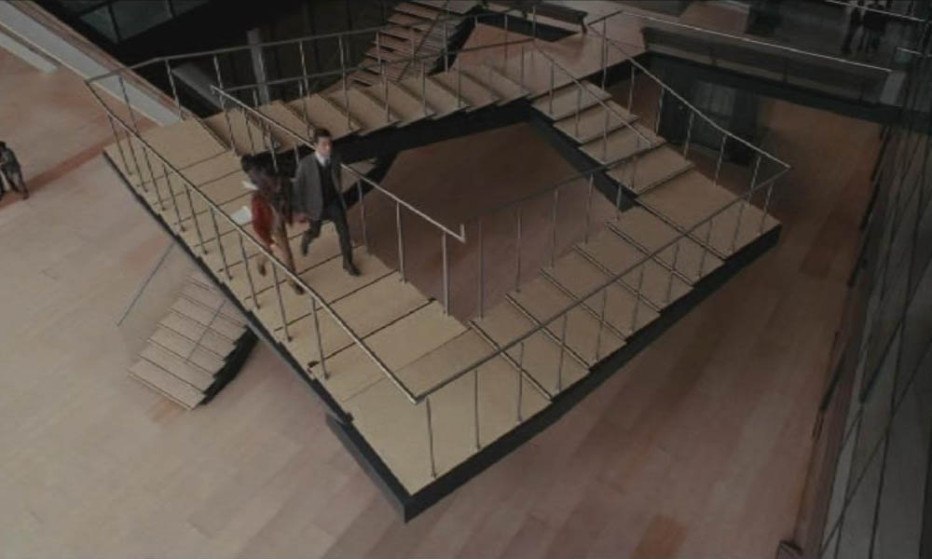
A reversible figure is a two dimensional figure that represents a three dimensional object in such a way that it can be seen from two different perspectives.


https://learnodo-newtonic.com/penrose-stairs-explanation-impossible-stairs


These are Penrose Stairs they represent a reversible figure because, it is possible to focus on the people walking forwards up the stairs, or walking backwards down the stairs.

Phi Phenomenon


Phi Phenomenon is the optical illusion in which we perceive a series of still images as a continuous motion, due to rapid succession.


With this Apple loading gif, we perceive the loading symbol to be one continuous motion, even though each of them are changing individually.